
News
EquiSeq Profiled on KRQE

11 Mar 2026
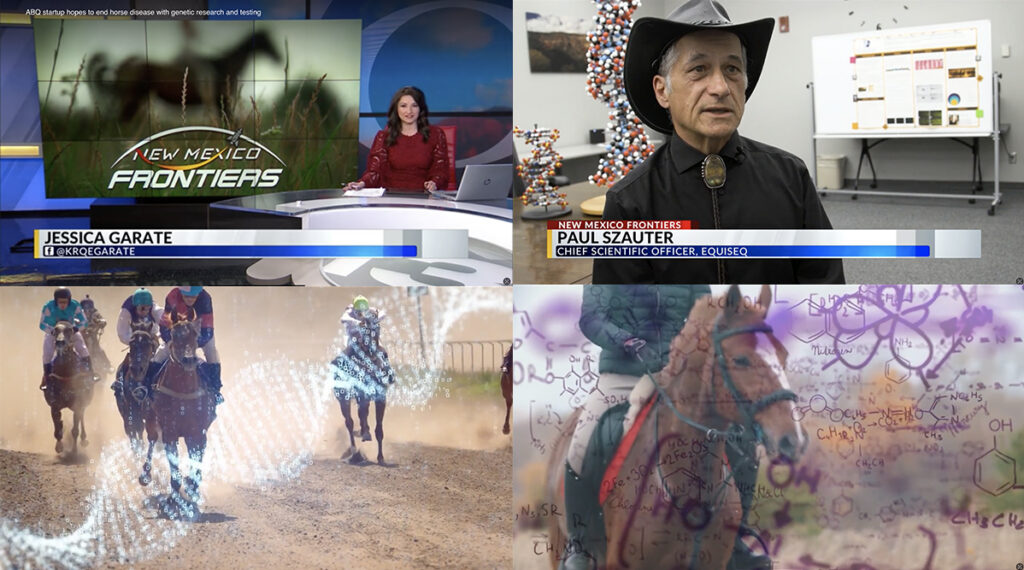
ABQ startup hopes to end horse disease with genetic research and testing.
View video on KRQE website.
Albuquerque, New Mexico – March 11, 2026
NEW MEXICO (KRQE) — Horses are just as much a part of New Mexico’s story as green chile and balloons. One local startup is hoping their research could lead to the end of a debilitating disease in the animal.
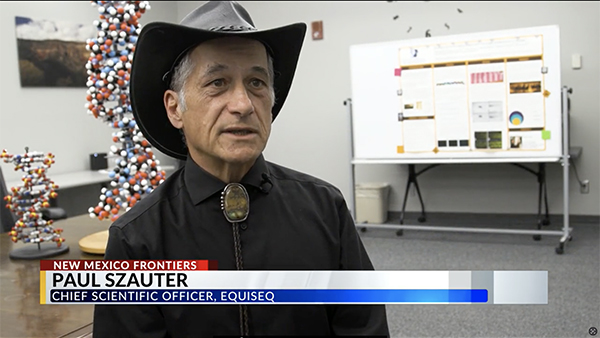
Paul Szauter openly admits – he’s not a horse person. “When I talk to horse owners… First 30 seconds, they can tell I’m not a horse person, right?” said Szauter.
What he does, however, could save future breeds of the animal from suffering a debilitating and painful disease. “Horses are very highly inbred. So they tend to sell horses on the basis of how famous the ancestors were, and if you have this big winning horse, they say, well, let’s have it on both sides of the pedigree, top and bottom,” said Szauter.
That practice can lead to genetic mutations within the animals that can cause a condition similar to muscular dystrophy in humans. “That’s called exercise intolerance. And the horse gets older, and it refuses to do the work that it’s been asked to do,” said Szauter. “And sometimes it’ll have an episode of what’s called tying up, where the muscles freeze up, and it needs veterinary attention.”
Szauter is chief scientific officer for EquiSeq, a New Mexico start-up that began its genetic research and testing more than a decade ago. “So when we started in 2015, we saw that, you know, there were some genetic tests for horses, but there were over 5,000 genetic tests for human beings, for inherited diseases. And in horse, there were 16,” said Szauter.
Researchers decided to start with six genetic tests for the disease, and since most mammals’ muscular DNA is similar, they used what we knew about human abnormalities to start their research in horses. “All mammals are really closely related, and humans and horses have pretty much the same set of genes. And especially muscle. Muscles are really ancient function that goes back to the origin of multicellular animals, like 570 years ago, million years ago. So, that’s a long time. And muscle has been around for a long time. And if you look even in fruit flies, you can find some of the muscle genes that are in humans and horses,” said Szauter.
Szauter says horse owners should look out for a number of symptoms in their animals between the ages of seven to 10 years old. “If you can read a horse’s face, you can see when it’s in pain,” said Szauter.
Additionally, the horse’s gait can show changes signaling that it’s in distress, especially in the canter, which is just below a full gallop. “What happens in these horses is both hind legs come up together, so they don’t have the strength to or the mobility to move those hind legs separately,” said Szauter. “So that’s called bunny hopping. They bring those hind legs up together.”
Over time, that can lead to the animal’s inability to stand. “And that’s typically when they’re euthanized,” said Szauter.
EquiSeq’s goal is to provide tools to breeders as well as potential horse buyers. By identifying the genetic abnormality, the disease could potentially be bred out from future generations. “Horses are bred deliberately. And if we had a genetic test that predicted the onset of these diseases, we could, over several generations, breed it out. And that’s what we’re trying to do,” said Szauter.
EquiSeq received its second of two patents covering their genetic testing in December of 2025. Their first patent request was submitted in 2017. Their hope is to continue developing tests that will better inform owners and breeders as to the health of their animals. “So it took eight years of fighting to get our patent issued, an expensive and time-consuming journey, but then the test is protected,” said Szauter.
Owning these patents, and others to come from this research, makes EquiSeq poised for exponential growth. Szauter said they’re hoping to attract investors, as well as larger entities such as the Mars Corporation, to scale up research, development, and solutions for these majestic animals. “We have ongoing research to discover additional variants,” said Szauter.
EquiSeq is also uniquely situated for development in New Mexico. In addition to state-of-the-art institutions like Sandia National Laboratories and Los Alamos National Laboratory, the animal is woven into the fabric of our state’s identity. “There’s a great history of horses in New Mexico. It’s part of the romance of the West. So it’s mythic to work on horses here,” said Szauter.
Szauter said that once hair samples are received from a client, it typically takes about two weeks to get results back. While they’re currently focused on the six tests that have been patented, they hope to expand the types of genetic testing they can do in the future.
Share this post
From the blog
The latest industry news, interviews, technologies, and resources.
EquiSeq Profiled on KRQE
ABQ startup hopes to end horse disease with genetic research and testing. View…
11 Mar 2026

A Drug for PSSM?
INTRODUCTION A new drug that inhibits glycogen synthase I, encoded by GYS1, reduces…
20 Feb 2026

EquiSeq is a biotech company offering
genetic testing for horses.
Resources
