

News
Albuquerque The Magazine Profiles EquiSeq

2 Jul 2026

Albuquerque, New Mexico, USA
July 1, 2026
Albuquerque The Magazine profiled EquiSeq in its July 2026 issue.
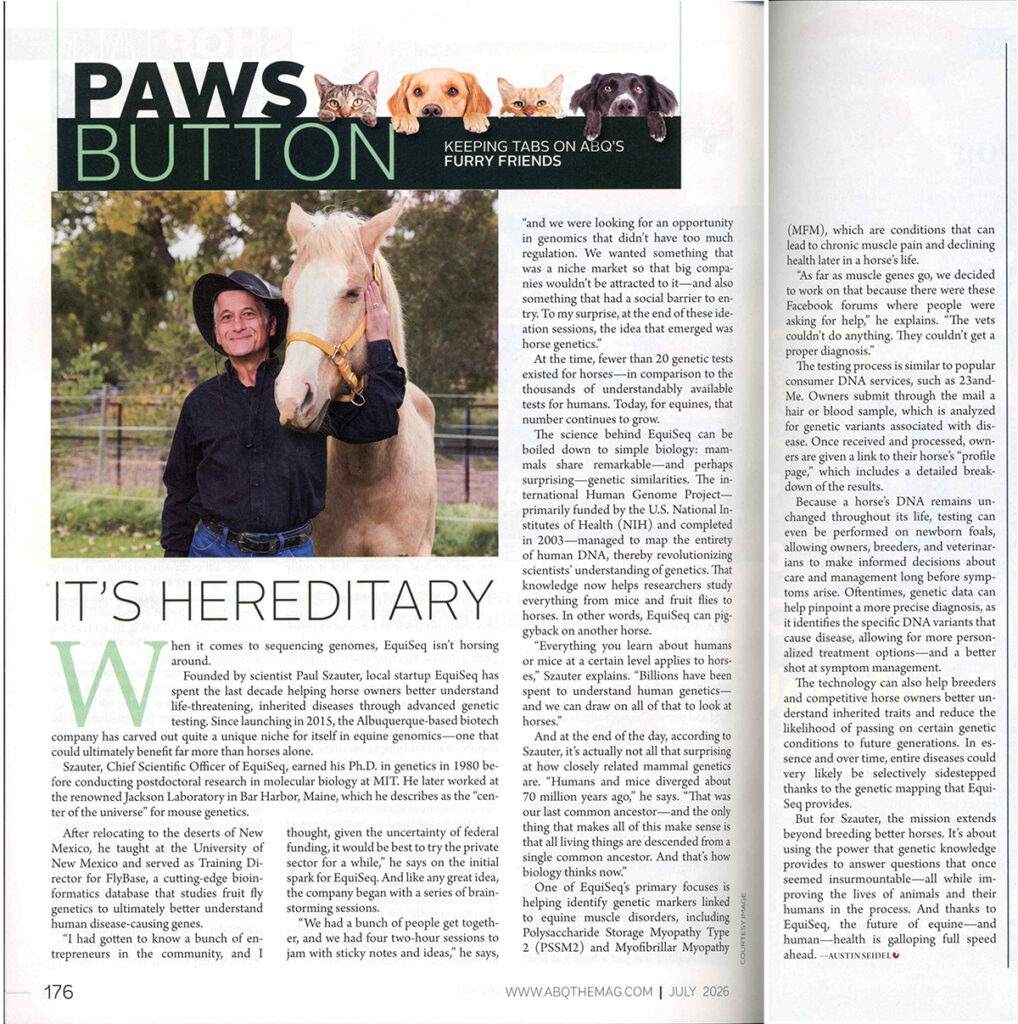
It’s Hereditary
Austin Seidel
When it comes to sequencing genomes, EquiSeq isn’t horsing around.
Founded by scientist Paul Szauter, local startup EquiSeq has spent the last decade helping horse owners better understand life-threatening, inherited diseases through advanced genetic testing. Since launching in 2015, the Albuquerque-based biotech has carved out quite a unique niche for itself in equine genomics – one that could ultimately benefit far more than horses alone.
Szauter, Chief Scientific Officer of EquiSeq, earned his Ph.D. in genetics in 1980 before conducting postdoctoral research in molecular biology at MIT. He later worked at the renowned Jackson Laboratory in Bar Harbor, Maine, which he describes as the “center of the universe” for mouse genetics.
After relocating to the deserts of New Mexico, he taught at the University of New Mexico and served as Training Director for FlyBase, a cutting-edge bioinformatics database that studies fruit fly genetics to ultimately better understand human disease-causing genes.
“I had gotten to know a bunch of entrepreneurs in the community, and I thought, given the uncertainty of federal funding, it would be best to try the private sector for a while,” he says on the initial spark for EquiSeq. And like any great idea, the company began with a series of brainstorming sessions.
“We had a bunch of people get together, and we had four two-hour sessions to jam with sticky notes and ideas,” he says, “and we were looking for an opportunity in genomics that didn’t have too much regulation. We wanted something that was a niche market so that big companies wouldn’t be attracted to it – and also something that had a social barrier to entry. To my surprise, at the end of those sessions, the idea that emerged was horse genetics.”
At the time, fewer than 20 genetic tests existed for horses – in comparison to the thousands of understandably available tests for humans. Today, for equines, that number continues to grow.
The science behind EquiSeq can be boiled down to simple biology: mammals share remarkable – and perhaps surprising – genetic similarities. The International Human Genome Project – primarily funded by the U.S. National Institutes of Health (NIH) and completed in 2003 – managed to map the entirety of human DNA, thereby revolutionizing scientists’ understanding of genetics. That knowledge now helps researchers study everything from mice and fruit flies to horses. In other words, EquiSeq can piggyback on another horse.
“Everything you learn about humans or mice at a certain level applies to horses,” Szauter explains. “Billions have been spent to understand human genetics – and we can draw on all of that to look at horses.”
And at the end of the day, according to Szauter, it’s not actually all that surprising at how closely related mammal genetics are. “Humans and mice diverged about 70 million years ago,” he says. “That was our last common ancestor – and the only thing that makes all of this make sense is that all living things are descended from a single common ancestor. And that’s how biology thinks now.”
One of EquiSeq’s primary focuses is helping identify genetic markers linked to equine muscle disorders, including Polysaccharide Storage Myopathy Type 2 (PSSM2) and Myofibrillar Myopathy (MFM), which are conditions that can lead to chronic muscle pain and declining health later in a horse’s life.
“As far as muscle genes go, we decided to work on that because there were Facebook forums where people were asking for help,” he explains. “The vets couldn’t do anything. They couldn’t get a proper diagnosis.”
The testing process is similar to popular consumer DNA services, such as 23andMe. Owners submit through the mail a hair or blood sample, which is analyzed for genetic variants associated with disease. Once received and processed, owners are given a link to their horse’s “profile page,” which includes a detailed breakdown of the results.
Because a horse’s DNA remains unchanged throughout its life, testing can even be performed on newborn foals, allowing owners, breeders, and veterinarians to make informed decisions about care and management long before symptoms arise. Oftentimes, genetic data can help pinpoint a more precise diagnosis, as it identifies the specific DNA variants that cause disease, allowing for more personalized treatment options – and a better shot at symptom management.
The technology can also help breeders and competitive horse owners better understand inherited traits and reduce the likelihood of passing on certain genetic conditions to future generations. In essence and over time, entire diseases could very likely be selectively sidestepped thanks to the genetic mapping that EquiSeq provides.
But for Szauter, the mission extends far beyond breeding better horses. It’s about using the power that genetic knowledge provides to answer questions that once seemed insurmountable – all while improving the lives of animals and their humans in the process. And thanks to EquiSeq, the future of equine – and human – health is galloping full speed ahead.
Share this post
From the blog
The latest industry news, interviews, technologies, and resources.
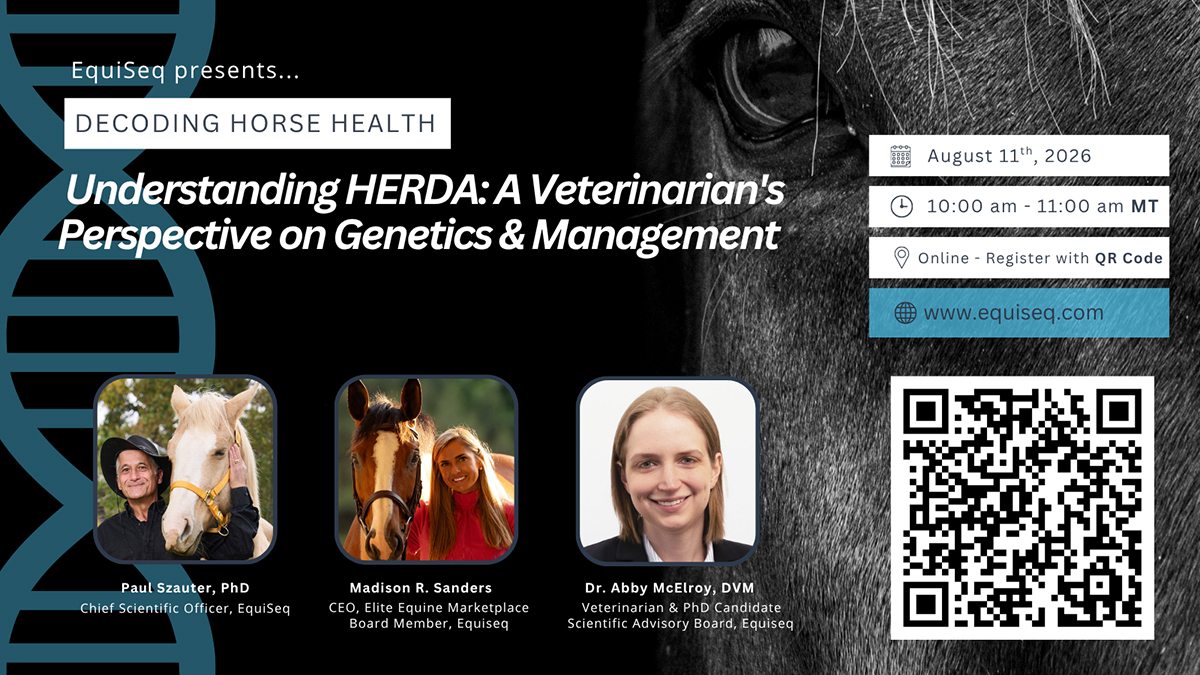
EquiSeq to present webinar on HERDA
Albuquerque, New Mexico July 29, 2026 EquiSeq will present a webinar entitled Understanding…
29 Jul 2026
Albuquerque The Magazine Profiles EquiSeq
Albuquerque, New Mexico, USA July 1, 2026 Albuquerque The Magazine profiled EquiSeq in…
2 Jul 2026

EquiSeq is a biotech company offering
genetic testing for horses.
Resources
