
Our blog
Resources and insights
The latest industry news, interviews, technologies, and resources.
Blog categories
News
EquiSeq Profiled on KRQE
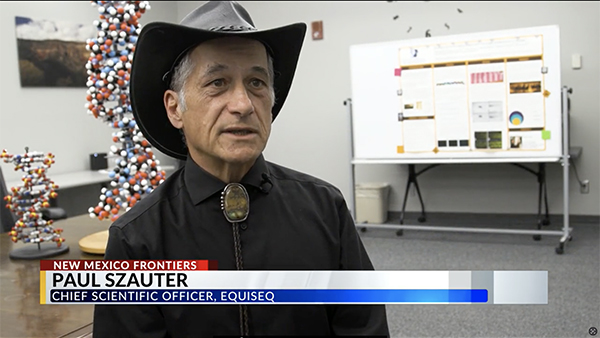
ABQ startup hopes to end horse disease with genetic research and testing. View video on KRQE website. Albuquerque, New Mexico – March 11, 2026 NEW MEXICO (KRQE) — Horses are just as much a part of New Mexico’s story as green chile and balloons. One local startup is hoping their research could lead to the end of a debilitating disease in the animal. Paul Szauter openly admits – he’s not a horse person. “When I talk to horse owners… First 30 seconds, they can tell I’m not a horse person, right?” said Szauter. What he does, however, could save future breeds of the animal from suffering a debilitating and painful disease. “Horses are very highly inbred. So they tend to sell horses on the basis of how famous the ancestors were, and if you have this big winning horse, they say, well, let’s have it on both sides of the pedigree, top and bottom,” said Szauter. That practice can lead to genetic mutations within the animals that can cause a condition similar to muscular dystrophy in humans. “That’s called exercise intolerance. And the horse gets older, and it refuses to do the work that it’s been asked to do,” said…

11 Mar 2026

Blog
A Drug for PSSM?
INTRODUCTION A new drug that inhibits glycogen synthase I, encoded by GYS1, reduces muscle glycogen in a mouse model of Pompe disease, a deficiency of the enzyme alpha-1,4-glucosidase, encoded by GAA (1). The first human trials of the drug in healthy volunteers show a reduction in muscle glycogen (2). It is likely that the drug will eventually be useful in treating horses with Polysaccharide Storage Myopathy type 1 (PSSM1), resulting from a variant of glycogen synthase I (GYS1-R309H) that causes constitutive activation of GYS1. The work on Pompe disease is summarized in an editorial (3). WHAT IS POMPE DISEASE? Human Pompe Disease (GSD2) is a glycogen storage disease caused by loss-of-function alleles of GAA, the gene encoding the lysosomal alpha-1,4-glucosidase (4, 5). Patients with Pompe disease are able to synthesize glycogen, but are unable to break down glycogen as a source of energy in muscle tissue. Some alleles with 1% of enzyme activity or less are associated with juvenile-onset Pompe disease, characterized by cardiomyopathy and hypotonic skeletal muscle. Other alleles with higher levels of residual enzyme activity present as adult-onset disease primarily affecting skeletal muscle. Human Pompe Disease is a recessive disorder, meaning that both alleles of GAA must be defective…
20 Feb 2026

News
EquiSeq Featured in Albuquerque Journal
ALBUQUERQUE, NEW MEXICO – January 11, 2026 EquiSeq was profiled in the Business section of the Albuquerque Journal on January 11, 2026. The article, by writer Hannah Garcia, described the company’s origins and the road ahead, based on interviews with Paul Szauter, Chief Scientific Officer; Madison Sanders, an equestrian who is a member of EquiSeq’s Board of Directors; and Jeremy Edwards, a scientist at the University of New Mexico. Coverage was prompted by the issuance of a second U.S. patent for DNA testing of horses to detect the predisposition to muscle disease. Please see the full article in the Albuquerque Journal.
12 Jan 2026

Blog
Riding Through MIM: A Test of Perseverance
A lot of people think finding out the horse that you’ve poured so much blood, sweat and tears into has a muscle disorder is one of the worst things that could happen. Sometimes, that’s true. Other times, it’s a relief. It’s a relief just to finally have an answer. It’s not one that I would wish on someone. It’s hard and complicated to get under control and manage over all. But it is possible. And it is possible to keep them happy and healthy… It just takes trial and error and a whole lot of patience to get there. And then some more, to keep them there. I currently have two very different horses with MIM. One is a registered Paint Horse gelding, Scooter. The other is Warmblood mare, Verona, with a full German passport. Bless the mini mare for saving my sanity and not being a candidate…. although she does have Heaves (just as annoying to manage but SO MUCH easier). As one of my friend’s pointed out, the Horse Distribution System really just pointed at me and yelled “chronic illness for this one.” Let’s start with the Paint. Watch This Move Doc or Scooter is 19 years old and…

8 Jan 2026
News
EquiSeq Announces Issuance of Second U.S. Patent to Detect Muscle Disease in Horses
ALBUQUERQUE, New Mexico – December 16, 2025 – EquiSeq Inc, a biotechnology company developing DNA tests for inherited muscle disease in horses, announced today that the United States Patent and Trademark Office has issued U.S. Patent Number 16/088,247, “Method of Detecting Inherited Equine Myopathy.” The patent includes claims covering specific genetic mutations that predispose to muscle disease in horses, allowing the design of a rational breeding program to reduce the incidence of equine muscle disease. The patent, and EquiSeq’s other patent, U.S. Patent Number 12,398,426, “Methods of Detecting Inherited Myopathies in Horses,” describe the use of DNA testing to identify damaging genetic variants in six different horse genes. The patented technology has been in commercial use since 2017, with over 15,000 horses tested. The test is sold directly to consumers, including horse owners, breeders, and veterinarians. The technology has been licensed by Generatio GmbH, a company in Germany that provides equine genetic testing for Europe. DNA testing is a well-established technology that works reliably on all DNA, regardless of the source. In the United States, EquiSeq uses allele-specific PCR, a rapid test that returns results quickly enough for a pre-purchase exam. In Germany, Generatio uses an Illumina BeadArray, a comprehensive test for tens of thousands of variants….
16 Dec 2025

News
EquiSeq Holds First Webinar
ALBUQUERQUE, NEW MEXICO – November 13, 2025 EquiSeq held its first Decoding Horse Health webinar on Zoom on November 11, 2025. Madison Sanders (Elite Equine Marketplace and EquiSeq) interviewed Paul Szauter, PhD (EquiSeq’s Chief Scientific Officer) and Stephanie Carter, FNTP (Indigo Ancestral Health). The webinar focused on inherited muscle disease in horses. Dr. Szauter discussed the founding of the company, the research behind its patented tests, and methods used to evaluate scientific work, including review by patent examiners and the peer-reviewed scientific literature. Stephanie Carter, who recently published Managing Muscle Mayhem, discussed management of affected horses through diet and other means. She reported that some affected horses are able to return to work of some kind with proper management. People attending the webinar were able to ask questions. The panelists expressed hope that this webinar will facilitate communication between horse owners and their veterinarians on this emerging area of horse health. A video of the webinar is posted on the Decoding Horse Health channel on YouTube.
13 Nov 2025

News
EquiSeq’s DNA Test Changes the Landscape
ALBUQUERQUE, NEW MEXICO – October 14, 2025 The October 2025 issue of Equine Business Magazine published an article on EquiSeq, describing its DNA test as changing the landscape in managing horse health. Madison Ruddy Sanders, founder of Elete Equine Marketplace and a member of EquiSeq’s Board of Directors, wrote the article, based on conversations with Paul Szauter, EquiSeq’s Chief Scientific Officer; Stephanie Carter, an equine nutritionist; and horse owners Wendee Walker and Charlene Shingleton. EquiSeq’s patented DNA tests identify horses at risk for a muscle disease before they develop symptoms. Unlike muscle biopsy, EquiSeq’s DNA test is noninvasive, only requiring a hair sample. The article is one of the outcomes of EquiSeq’s recent outreach to horse owners. Madison Sanders and Paul Szauter have interviewed horse owners via Zoom, offering the opportunity for horse owners to write guest blog posts for EquiSeq’s website. They are currently planning public webinars to address horse muscle disease.
14 Oct 2025

Blog
An Elephant to Discuss in the Equestrian Community
I’m an amateur dressage rider, Animal Reiki Practitioner, and trail enthusiast looking for my next happy, healthy trail partner. That means I’m horse shopping, which should be an exciting experience! As of Summer 2025, I tested 19 horses for PSSM2/MIM as part of my pre-purchase process. These horses came from all backgrounds registered and grade. Draft crosses. Iberians. Morgans. Mustangs from the same herd. Even a grade Haflinger. Over half of the horses I tested carry one or more variants of PSSM2/MIM. The breeder of my affected horse, insisted the genes don’t guarantee clinical signs. Other skeptics say, “correlation doesn’t equal causation,” as if that explains away the welfare concerns many owners are seeing firsthand. Maybe if your horse is a companion, or breeding stock not in work, you’ll never know. If they’re only used for breeding, and get trimmed twice a year, the cracks in health might stay hidden. But once they’re asked to work, the signs of pain are revealed. Stiffness. Resentment. Resistance. And acting like just being a horse is hard. Many are dangerously explosive. A grouchy “pain face” might be the only clue. These horses struggle to trailer and settle into a new environment as well….

1 Oct 2025

Blog
Muscles as Messengers: How Muscle Myopathies Are Revolutionizing Equine Health Care
After two decades in the veterinary medical field, I’ve witnessed countless treatment protocols, diagnostic advances, and management trends. Yet nothing has transformed my understanding of equine health quite like muscle myopathies. These complex conditions—PSSM1, MIM and its variants, MFM, MYHM, and so forth—have become unexpected catalysts, revealing fundamental truths about health that extend far beyond the horses they affect. What makes these conditions so instructive isn’t their complexity, it’s their honesty. Unlike many equine ailments that respond to pharmaceutical intervention, muscle myopathies strip away our comfortable reliance on medical management. They demand something more fundamental: a return to species-appropriate nutrition, natural movement patterns, and collaborative care that honors the whole horse. When Medicine Meets Its Match In my years as an equine nutrition professional, I’ve consulted on hundreds of muscle myopathy cases. The pattern is strikingly consistent: owners arrive having tried every supplement, every medication, every promise of a solution. Their horses continue to struggle. Not because the veterinary care was inadequate, but because these conditions require something medicine alone cannot provide. This is where beauty emerges from the burden. When conventional treatments offer minimal relief, we’re forced to examine our husbandry practices and whether our convenient systems serve the…

10 Sep 2025

News
EquiSeq Announces Issuance of U.S. Patent to Detect Genetic Variants Causing Muscle Disease in Horses
ALBUQUERQUE, New Mexico – September 2, 2025 – EquiSeq Inc, a biotechnology company developing DNA tests for inherited muscle disease in horses, announced today that the United States Patent and Trademark Office has issued U.S. Patent Number 12,398,426, “Methods of Detecting Inherited Myopathies in Horses.” The patent includes claims covering specific genetic mutations that predispose to muscle disease in horses, allowing the design of a rational breeding program to reduce the incidence of equine muscle disease. The patent, and EquiSeq’s other patent, U.S. Patent Number 16/088,247, “Method of Detecting Inherited Equine Myopathy,” describe the use of DNA testing to identify damaging genetic variants in six different horse genes. The patented technology has been in commercial use since 2017, with thousands of horses tested. The test is sold directly to consumers, including horse owners, breeders, and veterinarians. The technology has been licensed by Generatio GmbH, a company in Germany that provides equine genetic testing for Europe. DNA testing is a well-established technology that works reliably on all DNA, regardless of the source. In the United States, EquiSeq uses allele-specific PCR, a rapid test that returns results quickly enough for a pre-purchase exam. In Germany, Generatio uses an Illumina BeadArray, a comprehensive test for tens of thousands of variants….
2 Sep 2025

EquiSeq is a biotech company offering
genetic testing for horses.
Resources
