
Our blog
Resources and insights
The latest industry news, interviews, technologies, and resources.
Blog categories
News
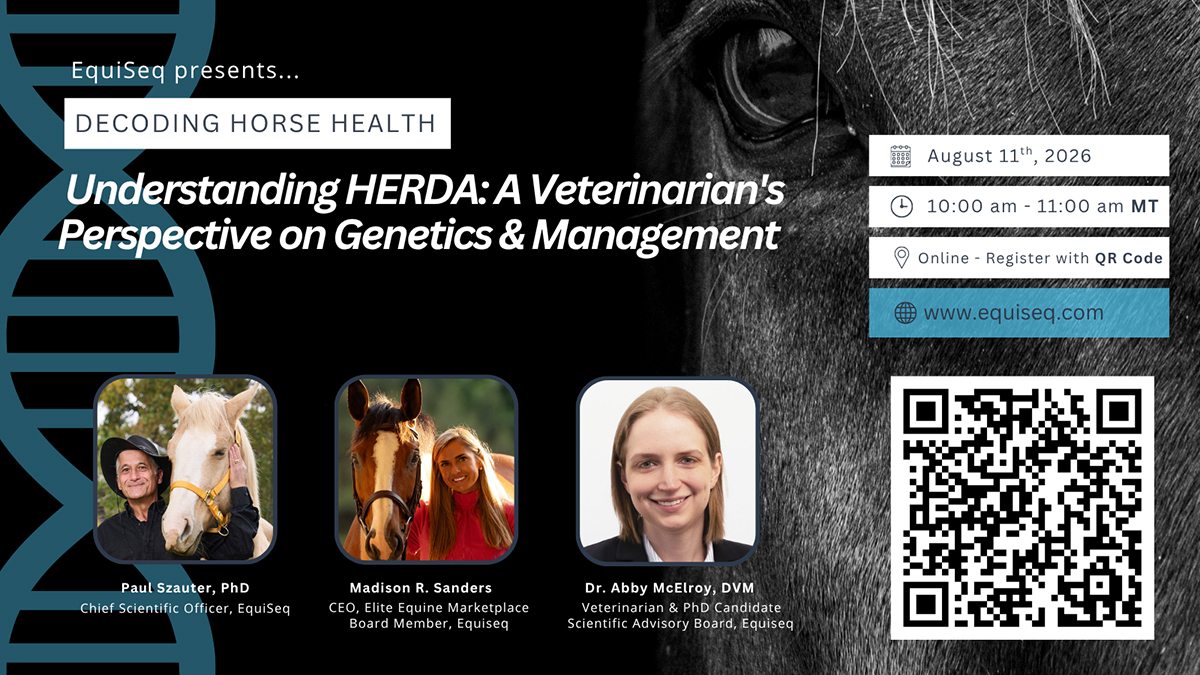
EquiSeq to present webinar on HERDA
Albuquerque, New Mexico July 29, 2026 EquiSeq will present a webinar entitled Understanding HERDA: A Veterinarian’s Perspective on Genetics & Management on Tuesday, August 11, at 10:00 am MDT (12:00 pm EDT) on Zoom. The webinar features Dr. Abby McElroy, DVM, who has conducted research on horses with HERDA. Join us for the next Decoding Horse Health webinar as we take a closer look at HERDA (Hereditary Equine Regional Dermal Asthenia)—a genetic condition that can have a significant impact on horse health and breeding decisions. In this free educational webinar, Dr. Abigail McElroy, DVM, MS, veterinarian, HERDA researcher, and PhD candidate at UMass Chan Medical School, will share her expertise on: What HERDA is and how it affects horses The genetics and inheritance behind the disease Diagnosis, DNA testing, and why it matters Current management strategies and what the future of HERDA research looks like She’ll be joined by Paul Szauter, PhD, Founder & Chief Scientific Officer of EquiSeq, for an engaging discussion on the science behind HERDA and what every horse owner, breeder, and equine professional should know. Whether you’re a horse owner, breeder, veterinarian, or simply passionate about equine health, this is an opportunity to learn from experts at the forefront of…

29 Jul 2026

News
Albuquerque The Magazine Profiles EquiSeq
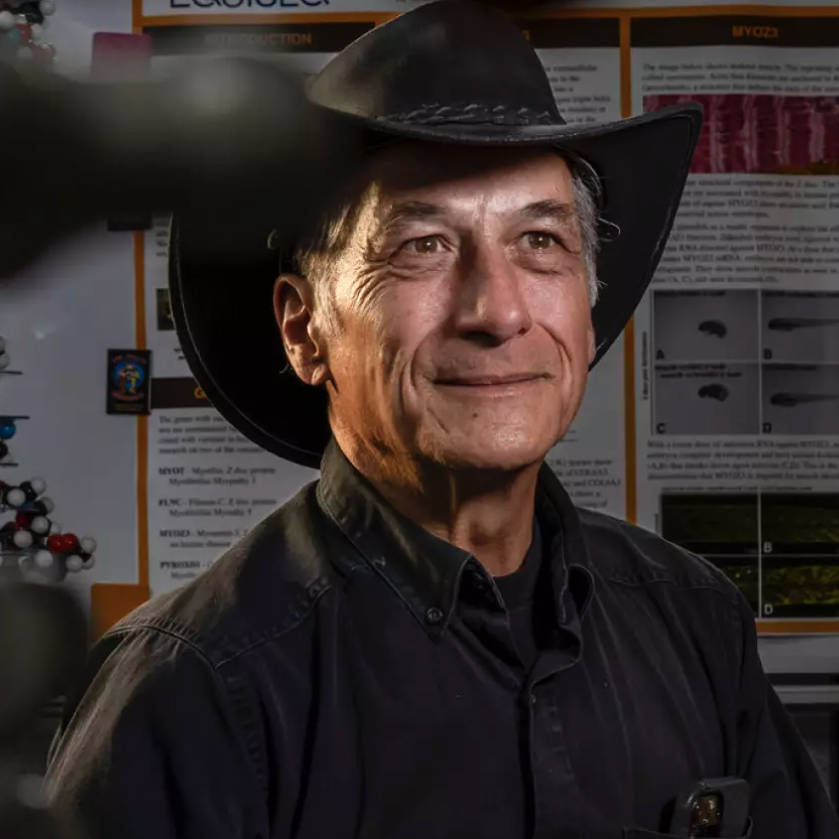
Albuquerque, New Mexico, USA July 1, 2026 Albuquerque The Magazine profiled EquiSeq in its July 2026 issue. It’s Hereditary Austin Seidel When it comes to sequencing genomes, EquiSeq isn’t horsing around. Founded by scientist Paul Szauter, local startup EquiSeq has spent the last decade helping horse owners better understand life-threatening, inherited diseases through advanced genetic testing. Since launching in 2015, the Albuquerque-based biotech has carved out quite a unique niche for itself in equine genomics – one that could ultimately benefit far more than horses alone. Szauter, Chief Scientific Officer of EquiSeq, earned his Ph.D. in genetics in 1980 before conducting postdoctoral research in molecular biology at MIT. He later worked at the renowned Jackson Laboratory in Bar Harbor, Maine, which he describes as the “center of the universe” for mouse genetics. After relocating to the deserts of New Mexico, he taught at the University of New Mexico and served as Training Director for FlyBase, a cutting-edge bioinformatics database that studies fruit fly genetics to ultimately better understand human disease-causing genes. “I had gotten to know a bunch of entrepreneurs in the community, and I thought, given the uncertainty of federal funding, it would be best to try the private…
2 Jul 2026

News
Veterinarian Joins EquiSeq Board
Albuquerque, New Mexico, USA June 29, 2026 EquiSeq, a leader in developing genetic tests for horses, is pleased to announce the appointment of Dr. Abigail McElroy, an equestrian and veterinarian currently working on a PhD, to its Board of Directors and Scientific Advisory Board. Dr. McElroy earned her veterinary degree from the Cummings School of Veterinary Medicine at Tufts University in 2017. She then completed a Master’s degree at Michigan State University in 2018, where her research focused on characterizing neurological abnormalities associated with hereditary equine regional dermal asthenia (HERDA). Dr. McElroy is currently a Millennium PhD Candidate at the University of Massachusetts Chan Medical School, where her research focuses on developing a gene therapy for dermatosparaxis Ehlers-Danlos syndrome. In addition to her research, she works part-time in clinical veterinary practice. Abby is also an enthusiastic polo player. “I am thrilled to join both the EquiSeq Board and Scientific Advisory Board,” Dr. McElroy said in a statement. “I bring over 30 years of experience as a horse owner and sport horse competitor to the company, as well experience as a veterinarian with a background in equine genetics. I am excited about the direction that EquiSeq’s research is headed in, and…
29 Jun 2026

News
Carnegie Mellon University Profiles EquiSeq Founder
April 20, 2026 – Pittsburgh, Pennsylvania The alumni magazine for Carnegie Mellon published an article about Carnegie Mellon alumnus Paul Szauter (B.S. in Biological Sciences, 1976) founder and Chief Scientific Officer of EquiSeq. Read the full article at Carnegie Mellon’s website.
22 Apr 2026

News
EquiSeq hosts webinar on Recurrent Exertional Rhabdomyolysis (RER)
ALBUQUERQUE, NEW MEXICO – April 4, 2026 EquiSeq hosted a webinar on Recurrent Exertional Rhabdomyolysis (RER) on March 30, 2026. Our guest was Kirsten Dimmler, PhD, who recently completed her dissertation on RER at the University of Minnesota under the direction of Dr. Molly McCue. Moderator Madison Sanders and EquiSeq’s Chief Scientific Officer, Paul Szauter, PhD, joined Kirsten for this discussion of what is known, and what is emerging, about this genetically complex disease. In the video, Kirsten reviews current management practices for horses with RER, offering practical advice for owners of affected horses. The video description on the Decoding Horse Health channel on YouTube contains timestamps, allowing horse owners to navigate to specific parts of the video.
4 Apr 2026
News
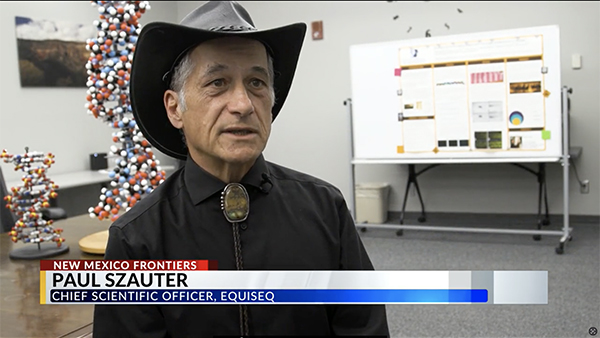
EquiSeq Profiled on KRQE
ABQ startup hopes to end horse disease with genetic research and testing. View video on KRQE website. Albuquerque, New Mexico – March 11, 2026 NEW MEXICO (KRQE) — Horses are just as much a part of New Mexico’s story as green chile and balloons. One local startup is hoping their research could lead to the end of a debilitating disease in the animal. Paul Szauter openly admits – he’s not a horse person. “When I talk to horse owners… First 30 seconds, they can tell I’m not a horse person, right?” said Szauter. What he does, however, could save future breeds of the animal from suffering a debilitating and painful disease. “Horses are very highly inbred. So they tend to sell horses on the basis of how famous the ancestors were, and if you have this big winning horse, they say, well, let’s have it on both sides of the pedigree, top and bottom,” said Szauter. That practice can lead to genetic mutations within the animals that can cause a condition similar to muscular dystrophy in humans. “That’s called exercise intolerance. And the horse gets older, and it refuses to do the work that it’s been asked to do,” said…
11 Mar 2026

Blog
A Drug for PSSM?
INTRODUCTION A new drug that inhibits glycogen synthase I, encoded by GYS1, reduces muscle glycogen in a mouse model of Pompe disease, a deficiency of the enzyme alpha-1,4-glucosidase, encoded by GAA (1). The first human trials of the drug in healthy volunteers show a reduction in muscle glycogen (2). It is likely that the drug will eventually be useful in treating horses with Polysaccharide Storage Myopathy type 1 (PSSM1), resulting from a variant of glycogen synthase I (GYS1-R309H) that causes constitutive activation of GYS1. The work on Pompe disease is summarized in an editorial (3). WHAT IS POMPE DISEASE? Human Pompe Disease (GSD2) is a glycogen storage disease caused by loss-of-function alleles of GAA, the gene encoding the lysosomal alpha-1,4-glucosidase (4, 5). Patients with Pompe disease are able to synthesize glycogen, but are unable to break down glycogen as a source of energy in muscle tissue. Some alleles with 1% of enzyme activity or less are associated with juvenile-onset Pompe disease, characterized by cardiomyopathy and hypotonic skeletal muscle. Other alleles with higher levels of residual enzyme activity present as adult-onset disease primarily affecting skeletal muscle. Human Pompe Disease is a recessive disorder, meaning that both alleles of GAA must be defective…
20 Feb 2026
News
EquiSeq Featured in Albuquerque Journal
ALBUQUERQUE, NEW MEXICO – January 11, 2026 EquiSeq was profiled in the Business section of the Albuquerque Journal on January 11, 2026. The article, by writer Hannah Garcia, described the company’s origins and the road ahead, based on interviews with Paul Szauter, Chief Scientific Officer; Madison Sanders, an equestrian who is a member of EquiSeq’s Board of Directors; and Jeremy Edwards, a scientist at the University of New Mexico. Coverage was prompted by the issuance of a second U.S. patent for DNA testing of horses to detect the predisposition to muscle disease. Please see the full article in the Albuquerque Journal.
12 Jan 2026

Blog Testimonials
Riding Through MIM: A Test of Perseverance
A lot of people think finding out the horse that you’ve poured so much blood, sweat and tears into has a muscle disorder is one of the worst things that could happen. Sometimes, that’s true. Other times, it’s a relief. It’s a relief just to finally have an answer. It’s not one that I would wish on someone. It’s hard and complicated to get under control and manage over all. But it is possible. And it is possible to keep them happy and healthy… It just takes trial and error and a whole lot of patience to get there. And then some more, to keep them there. I currently have two very different horses with MIM. One is a registered Paint Horse gelding, Scooter. The other is Warmblood mare, Verona, with a full German passport. Bless the mini mare for saving my sanity and not being a candidate…. although she does have Heaves (just as annoying to manage but SO MUCH easier). As one of my friend’s pointed out, the Horse Distribution System really just pointed at me and yelled “chronic illness for this one.” Let’s start with the Paint. Watch This Move Doc or Scooter is 19 years old and…

8 Jan 2026

News
EquiSeq Announces Issuance of Second U.S. Patent to Detect Muscle Disease in Horses
ALBUQUERQUE, New Mexico – December 16, 2025 – EquiSeq Inc, a biotechnology company developing DNA tests for inherited muscle disease in horses, announced today that the United States Patent and Trademark Office has issued U.S. Patent Number 16/088,247, “Method of Detecting Inherited Equine Myopathy.” The patent includes claims covering specific genetic mutations that predispose to muscle disease in horses, allowing the design of a rational breeding program to reduce the incidence of equine muscle disease. The patent, and EquiSeq’s other patent, U.S. Patent Number 12,398,426, “Methods of Detecting Inherited Myopathies in Horses,” describe the use of DNA testing to identify damaging genetic variants in six different horse genes. The patented technology has been in commercial use since 2017, with over 15,000 horses tested. The test is sold directly to consumers, including horse owners, breeders, and veterinarians. The technology has been licensed by Generatio GmbH, a company in Germany that provides equine genetic testing for Europe. DNA testing is a well-established technology that works reliably on all DNA, regardless of the source. In the United States, EquiSeq uses allele-specific PCR, a rapid test that returns results quickly enough for a pre-purchase exam. In Germany, Generatio uses an Illumina BeadArray, a comprehensive test for tens of thousands of variants….
16 Dec 2025

EquiSeq is a biotech company offering
genetic testing for horses.
Resources
